
To serve as an introduction to the Public Works Department, its people and the challenges they faced, replicated below is an article written by Ray Arnold which was published in the Corona magazine in September 1960. Slide images from his collection have also been added where applicable to the text.
The Public Works Department in the Gambia
by R.H. Arnold
The sensation of landing on the steel plate runways of Yundum Airport and the first sight of the timber hut serving as the terminal building give an impression that the Gambia is a remote corner of the Commonwealth. However, the fairly comfortable lounge and modern bar, together with the helpful customs and other officials, result in a pleasant entry to the country before being quickly driven the fifteen miles to Bathurst.
In the modern hotel we meet our seagoing colleagues who have steamed up the estuary to Government Wharf where a crane is fighting a continual battle against the silting of the sand. Unfortunately the battle ceased for a time after the operator leaned too far forward, putting himself and crane over the edge of the wharf.
We now realise that Bathurst, which is the capital and only large town in the country, is situated at the end of a sand spit in the middle of the river. It would appear that the future of this sand spit is also the subject of a fight as the sea is trying desperately hard to wash it away while the Public Works Department meets all onslaughts with calculated defensive moves. The latest attempt at a break through was at a point three miles from Bathurst where the high water mark moved forward twenty feet in one day, to come within twenty feet of the edge of the road. A temporary rock breastwork was smartly put into place and the permanent work of building eleven timber groynes was done in only six weeks by the efficient use of a 19 R.B. excavator (fitted with pile driving attachment), a water jetting pump and by the co-operation and help of all concerned.

Further towards the mainland the sand spit is cut by the eight hundred feet wide Oyster Creek and it is here that there have been some anxious moments during the past years. In the autumn of 1959 one pier of the bridge was seen to be sinking gradually, together with the water main which was attached thereto. This was causing some consternation and the temperamental sea, the tide and the strong current did their best to delay remedial work. Despite these effects a system of timber piles and strutting was completed to provide a temporary support to the pier.
Meanwhile work had been started on the construction of a new bridge of pre-stressed concrete beams supported on tubular piles of eight-inch diameter but misfortune set in for a time. Two of the piles split during driving, the second one involving the loss of the five-ton driving hammer which stuck underground in the tube and refused to move. Later on the workers were beset by a strange illness thought to arise from a nearby groundnut decorticating mill. However, after the ceremonial killing of a black bull the bridge was completed without further serious mishap.
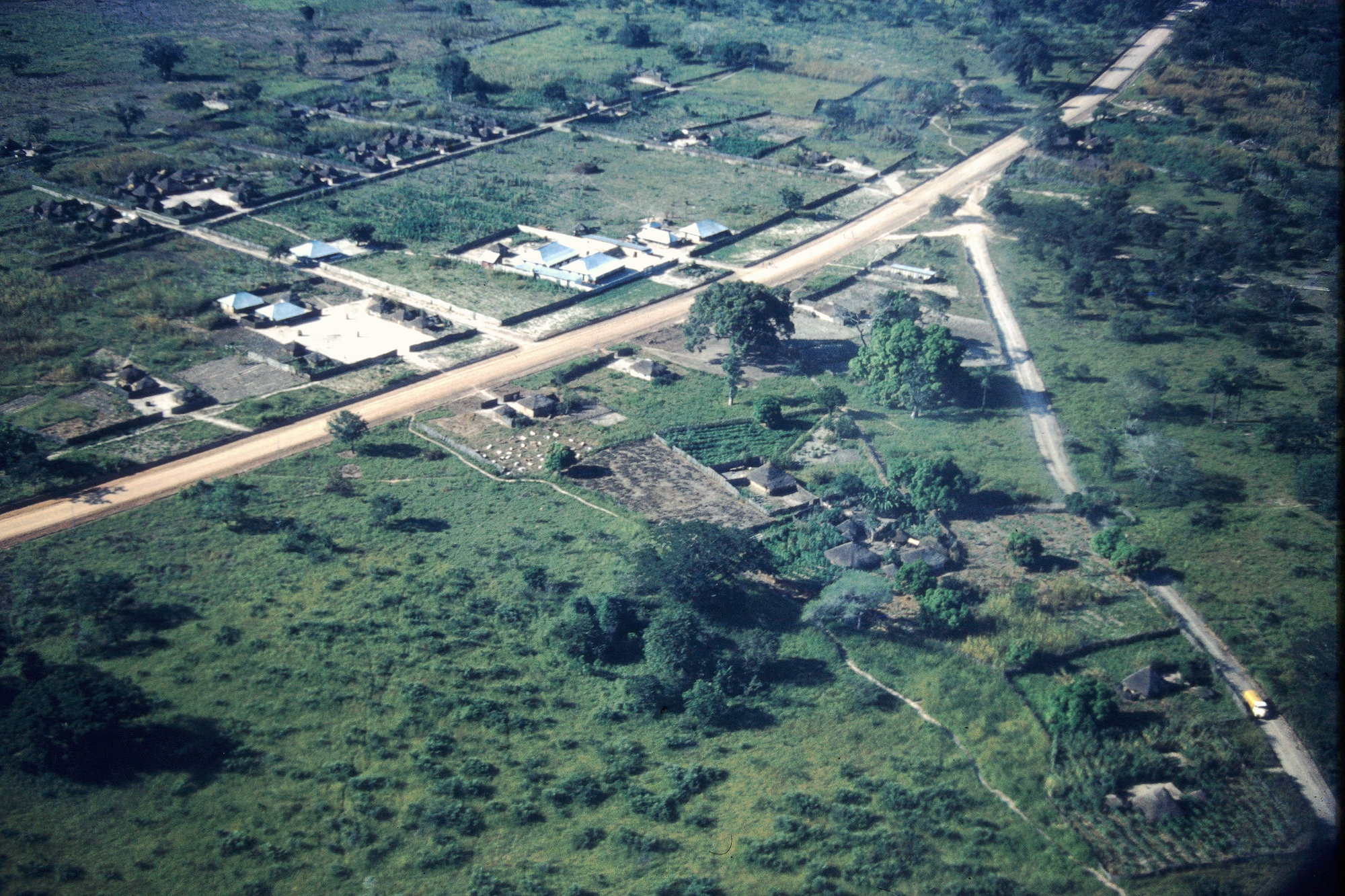
Passing over the bridge, we cross through rice fields to meet the road from Fajara (where a number of Government quarters are situated overlooking the Atlantic Ocean). Turning eastwards we travel parallel to the river and then pass the airport which is managed by a private Company for the Controller of Civil Aviation (alias Director of Public Works) and which also houses his Meteorological Section. Driving on another seven miles to Brikama, we have time to take a look at the flat countryside, with its miles of bush type vegetation plus the addition of high grass in the rainy season (June to October) and interspersed with palm trees and occasional woods. The sandy soil provides the Gambian with his annual crop of groundnuts which is cultivated entirely by hand although the Government is now introducing a system of ox ploughing to help the farmers. His transport is also becoming mechanised and this is taxing the capabilities of the roads which, up to this point, consist of gravel with three coats of bitumen sprayed on to lay the dust and to keep out the rain. It is almost impossible, however, to keep the gravel perfectly dry as the ground water table is high, so that the roads are often saturated and as a consequence are subject to rapid deterioration.
This threat is met in two ways, firstly by the introduction of a higher standard of maintenance which is slowly being attained without additional funds by the use of mechanisation and by concentrating the maintenance personnel into a small number of gangs for ease of supervision. The second method is to reconstruct the roads by using a stabilising agent in the gravel, but as this is relatively expensive it can only be carried out where traffic is sufficiently heavy and a start is being made in the main streets of Bathurst.

The roads beyond Brikama deteriorate into sand tracks, their greatest use being to give an indication of direction, but at the same time they do their best to shake the landrover to pieces. We see, however, that Gambia has its equivalent of the British motorway programme and that new gravel roads are being constructed by bulldozers, graders, mechanical loaders, trucks, rollers and tractors, and although they do not have a bitumen surface the volume of traffic is very low so that the roads will be adequate to attain the object of improving the communications of the country as quickly as possible. The programme is also being pushed ahead by the local contractors who construct a quarter of a mile of road at a time, using local labour and transport, while a mixture of mechanisation and contractors is being used to build spur roads leading to the numerous river wharves.
The construction and maintenance of these wharves is another responsibility of the Public Works Department and since the river is the present main traffic artery, there is a hue and cry every time one is put out of commission. These wharves are constructed from rhun palm, which is a hard fibrous type of timber, and the difficulties encountered in this work range from the problems of obtaining and transporting by land and river the necessary rhun palms from remote situations, and countering the effects of heavy seas in the lower reaches of the river and flooding in the upper regions.
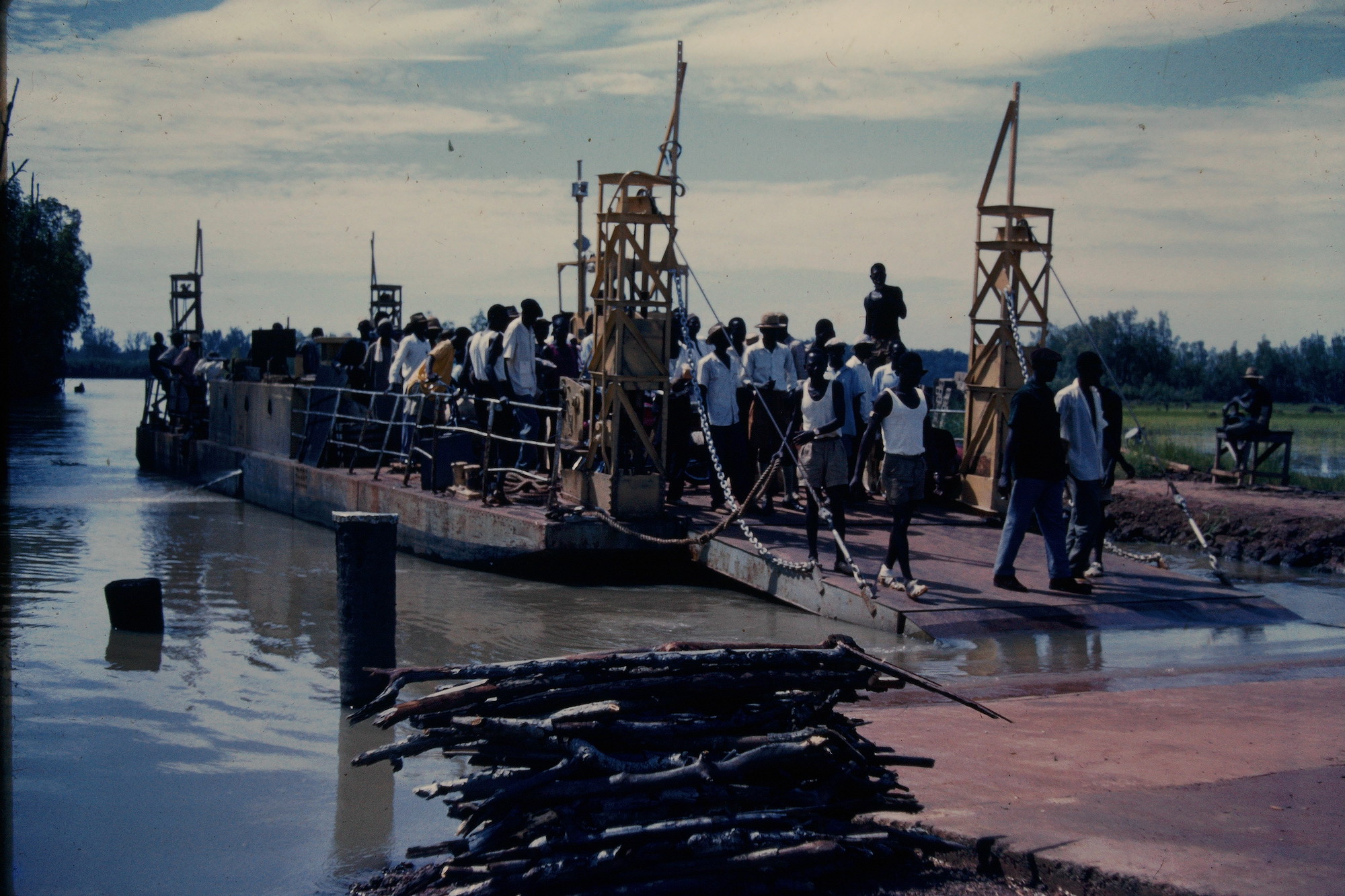
Another feature of the river is the numerous ferries which carry people, materials, transport, stores and cattle etc., across the river at various points. No amount of precautions can make these perfectly safe, especially for persons like the one who drove his truck at speed down the ferry ramp when the ferry did not happen to be there. On the whole, however, the problems of constructing reinforced concrete ramps in the swamps adjacent to the river are being overcome as soon as funds are made available.
The river is also used for washing, but the vast majority of people obtain all their water from the local village well which is usually a crude, unlined hole in the ground with water of doubtful quality drawn up with the aid of a bucket on a rope. There are, however, the villages which have already benefited from the Government’s well-sinking project and they have a well which is properly sited by an expert and is constructed with a concrete lining. Sometimes these wells also have a pump, but in all cases a plentiful supply of clean uncontaminated water is available throughout the whole year.
At the same time, a scheme is being carried out to improve the supply of water to Bathurst whose citizens are fortunate enough to enjoy the advantages of a mains supply. When the scheme is completed, water will be obtained from a number of boreholes mostly on the mainland. One borehole, 1,150 feet deep, has been drilled in Bathurst but this yields a somewhat brackish supply which also contains an excessive quantity of flourine. At present this water is mixed with the purer water from the mainland boreholes, in such proportions that the resulting product is palatable. At the same time, plans are being made to install a small pilot de-fluoridation plant to investigate the feasibility of reducing the fluorine content of the Bathurst deep borehole water, so that greater use can be made of this source of supply.
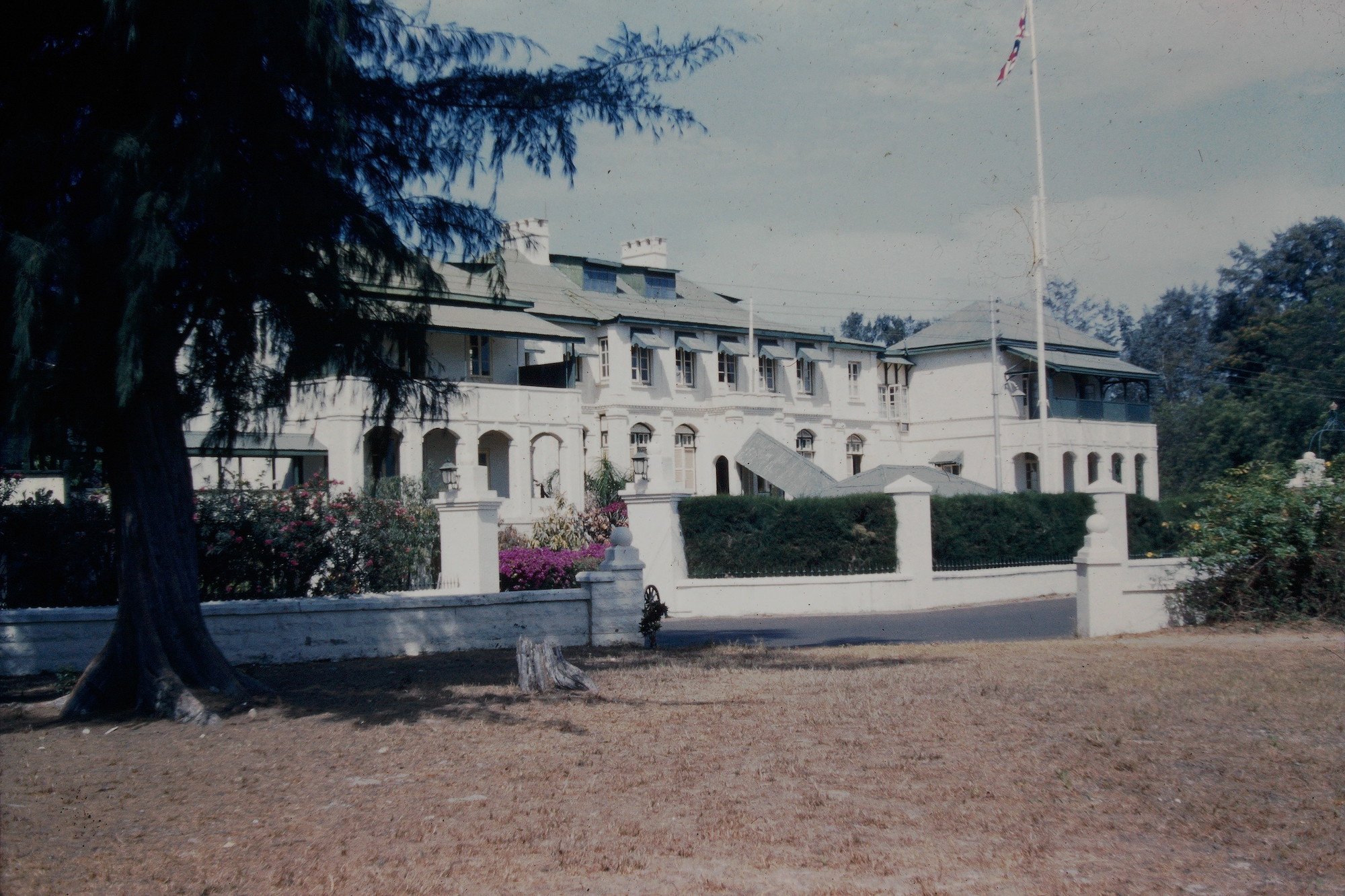
Following the course of the water services, we take a look at some of the Government buildings including Government House (undergoing much need modernisation), the Secretariat (a substantially built building which used to house the army headquarters garrison, including horses, in bygone days), old Public Courts and rambling offices, Government quarters of varied designs and also a number of new buildings such as the Electricity and Marine Headquarters, three storey flats and modern schools. One of the main maintenance problems is to counter the effect of white ants and this is being achieved by the use of metal doors, windows, purlins etc. But most of the older buildings have timber roofs which, if not attacked by the ants, are infested with bats producing an unpleasant odour. This latter problem is still being investigated and much difficulty is being encountered in reconciling the advice against pitched roofs on the grounds of bat infestation and the advice against flat concrete roofs in the tropics on the grounds of difficulty with expansion and waterproofing.
It is time now to turn to the Public Works Department headquarters, situated in Bathurst and occupying an old Royal Air Force seaplane base. It is here that we see the things which keep the Department ticking along. The Motor Transport and Plant Section occupies a seaplane hangar and carries out complete overhauls on the three hundred vehicles and items of plant to fit them for further long and arduous service. Another hangar is used as a main store for up to £175,000 worth of goods and acts as a wholesale and retail warehouse to ensure a ready supply of every conceivable item used on works, vehicles, repairs, etc. Yet another of these invaluable hangars houses the woodworking shop in which carpenters, joiners and machinists manufacture all furniture and built-in fitments for buildings, along with sheet piles for coast protection works, shuttering for concrete works and all other necessary timber items.
 In the old but cool timber offices, we find the Accounts Section and Cost Branches which manage to balance the books, the Engineers, Architect, Building Surveyor and the Directorate and Clerical Staffs. We have an expatriate staff of about twenty-five, senior Gambian staff number about fifteen, and our total staff, with the above, comes to approximately nine hundred and fifty. Our daily paid labour strength is around seventeen hundred. These are the people, and this is the organisation which are now slipping into gear for the colourful task of preparing decorations and pavilions and applying the spit and polish to the buildings and roads of the town in readiness for the eagerly anticipated Royal Visit which it is hoped will now take place in 1961.
Image shows the senior team of the Public Works Department led by,
John Sturt Pullinger O.M. - Director of Public Works (First row, centre)
Raymond Harry Arnold - Deputy Director of Public Works (First row, 4th seated)